
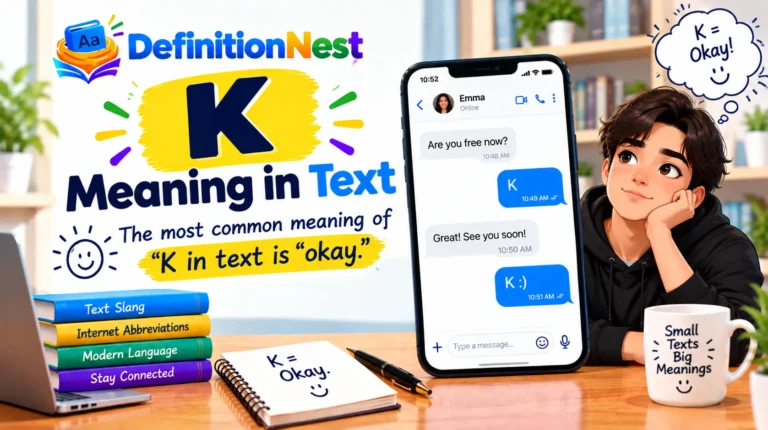
If someone sends you just “K” in a text, you may wonder what they really mean. Is it a simple “okay”? Are they upset? Are they trying to end the chat?
The answer depends on the context, relationship, and tone of the conversation.
In most texts, “K” means “okay.” It can show that a person understands something, agrees with it, or has received the message. However, a single “K” can sometimes sound cold, short, annoyed, or uninterested.
This is why understanding the k meaning in text is not always as simple as knowing the word “okay.”
What Does K Mean in Text?
The most common meaning of K in text is “okay.”
People use it as a short reply when they want to say:
- Okay
- Alright
- I understand
- Got it
- Fine
- Sure
For example:
Person 1: “I will call you after school.”
Person 2: “K”
Here, “K” most likely means “Okay, I understand.”
It is a very short form of “OK” or “okay.” People often use it because typing one letter is faster than writing a full word.
However, the meaning can change depending on how the conversation feels.
For example:
“K, see you tomorrow.”
This may sound normal and friendly.
But:
“K.”
can feel much colder.
The period and the lack of extra words can make the reply seem more serious or distant.
K Meaning in Text: Is It Always Rude?
No. “K” is not always rude.
Some people use “K” all the time because they like short messages. They may not be trying to sound angry or unfriendly.
For another person, however, “K” may feel too short.
This difference comes from texting habits.
Some people prefer messages such as:
- “Okay!”
- “Sure!”
- “Got it”
- “Alright”
- “K”
Others may use only one or two letters because they want to reply quickly.
So, you should not assume that someone is angry just because they sent “K.”
Look at the full conversation before deciding what they mean.
Why Does K Sometimes Sound Cold?
Text messages do not include voice tone, facial expressions, or body language. Because of this, a very short reply can sometimes feel different from the way it was intended.
Compare these messages:
“Okay!”
“Okay”
“K”
“K.”
All four can mean roughly the same thing, but they may give different feelings.
“K” can sound cold because it gives very little information. It may look like the person wants to finish the conversation.
For example:
You: “Sorry I forgot to send you the notes.”
Friend: “K.”
You might wonder if your friend is upset.
But if your friend normally uses one-word replies, the “K” may mean nothing serious.
The best way to understand it is to consider their normal texting style.
K vs. OK vs. Okay in Text
The words K, OK, and okay usually have the same basic meaning, but their tone can feel different.
K
“K” is the shortest version.
It can mean:
- Okay
- Got it
- Fine
- I understand
It can also feel brief or cold in some situations.
OK
“OK” is a little more complete.
It usually sounds neutral.
Example:
“OK, I will be there at 5.”
This sounds clear and normal.
Okay
“Okay” feels more natural and complete in many conversations.
Example:
“Okay, I understand what you mean.”
It can sound warmer because the person is using the full word.
Okay!
Adding an exclamation mark can make the message feel more positive or energetic.
Example:
“Okay! See you soon.”
The important point is that none of these forms has one fixed emotional meaning. The conversation matters.
What Does K Mean From a Friend?
When a friend sends “K,” it can mean several things.
They may simply be saying:
“Okay, I got it.”
For example:
You: “Meet me outside the library.”
Friend: “K”
That is probably just a quick confirmation.
But if you were having an argument before the message, “K” may have a different tone.
For example:
You: “I don’t think we should talk about this right now.”
Friend: “K.”
In this situation, the reply could sound upset, disappointed, or distant.
So when someone says “K,” ask yourself:
- What were we talking about?
- Were we arguing?
- Does this person normally text this way?
- Did they add anything else?
- Did their texting style suddenly change?
These clues can help you understand the message.
What Does K Mean From a Girl?
If a girl texts you “K,” it usually means “okay.”
It does not automatically mean she is angry or annoyed.
Her meaning depends on the situation and her normal texting style.
For example:
You: “The movie starts at 7.”
Her: “K”
This may simply mean she received the information.
But if you were discussing something serious and she suddenly changes from longer replies to only “K,” she might be unhappy or not interested in continuing the conversation.
Do not try to guess her feelings from one letter alone.
Look at the whole conversation.
What Does K Mean From a Boy?
If a boy texts “K,” it also usually means “okay.”
Many people use “K” because it is fast and easy.
For example:
You: “Don’t forget your homework.”
Him: “K”
This probably means:
“Okay, I won’t forget.”
If the person normally sends longer messages but suddenly replies with only “K,” it may be worth paying attention to the change in tone.
Still, one short message is not enough to know exactly how someone feels.
Does K Mean Someone Is Mad?
Sometimes, but not always.
A “K” can sound annoyed when it appears during an argument or after a disagreement.
For example:
Person 1: “I already told you I can’t come.”
Person 2: “K.”
Here, the short reply may suggest frustration or disappointment.
But in a normal conversation:
Person 1: “I’ll send the file tonight.”
Person 2: “K”
There may be no anger at all.
The context is more important than the letter itself.
Does “K” Mean the Conversation Is Over?
It can.
When someone replies with only “K,” they may be showing that they have nothing else to add.
For example:
You: “I have to go now.”
Friend: “K”
This can simply mean:
“Okay, bye.”
In another conversation, “K” may be used to end a topic.
It does not necessarily mean the person dislikes you. They may just be busy, tired, or finished talking about that subject.
K Meaning in Texting Slang
In modern texting, K is often treated as a casual abbreviation rather than a special slang word.
Its main meaning remains:
K = Okay
People may use it in:
- Text messages
- Group chats
- Social media messages
- Online games
- Comments
- Casual conversations
Because texting is fast, short forms are common.
Other examples include:
- “u” for “you”
- “r” for “are”
- “idk” for “I don’t know”
- “brb” for “be right back”
- “ty” for “thank you”
However, “K” is different from many slang terms because almost everyone understands its basic meaning.
K Meaning in Text From a Crush or Someone You Like
If someone you like sends “K,” it is easy to overthink it.
You might wonder:
“Are they annoyed?”
“Do they not like me?”
“Did I say something wrong?”
One “K” cannot answer these questions.
Pay attention to the larger pattern.
If they normally talk to you, ask questions, and continue conversations, one short “K” may simply mean they were busy.
If their replies have become consistently short and they stop showing interest in conversations, that gives you more useful information than one message.
Do not build a conclusion around a single letter.
K Meaning in Text After an Argument
After an argument, “K” can feel much stronger.
Imagine this:
You: “I don’t agree with you.”
Other person: “K.”
The “K” may mean:
- “Fine.”
- “I hear you.”
- “I’m done arguing.”
- “I don’t want to discuss this anymore.”
Sometimes people use it because they do not know what else to say.
If you think someone is upset, the best choice is usually to communicate clearly instead of guessing.
You could ask:
“Are we okay?”
or
“Did that bother you?”
A simple question can prevent a small misunderstanding from becoming a bigger one.
K vs. “KK” in Text
“KK” is often a more casual or friendly version of “K.”
It can mean:
- Okay
- Alright
- Sure
- Got it
For example:
“KK, I’ll see you later.”
This often feels lighter than a single “K.”
Still, texting habits are different from person to person.
Some people use “KK” because they naturally like short replies. Others may never use it.
There is no universal rule that says “KK” always means one specific emotion.
K vs. “Kay” in Text
“Kay” can also be used as a casual form of “okay.”
For example:
“Kay, I’ll do it later.”
Depending on the conversation, “kay” may sound relaxed or playful.
But it can also be used in a serious way.
As with “K,” context matters.
K With a Period: “K.”
The message “K.” can feel more serious than “K” to many people.
The period can make the reply look final.
Compare:
K
and
K.
The first may look like a quick response.
The second may feel like:
“Okay. End of discussion.”
However, some people automatically use punctuation in every message.
If they always write complete sentences with periods, then “K.” may not be a sign of anger.
This is why knowing someone’s normal texting habits is useful.
K With Other Words
“K” does not always appear alone.
You may see messages such as:
- “K thanks”
- “K sure”
- “K got it”
- “K bye”
- “K no problem”
- “K see you”
These messages are usually easy to understand because the extra words provide more context.
For example:
“K, see you tomorrow.”
sounds like a simple confirmation.
“K, whatever.”
can sound dismissive or annoyed.
The word that comes after “K” can greatly change the tone.
What Should You Reply to K?
Your reply depends on the conversation.
If someone says:
“K”
you do not always need to respond.
If the conversation is finished, you can leave it there.
If you want to continue, you can ask a question or add useful information.
For example:
Them: “K”
You: “Thanks. I’ll message you when I get there.”
Or:
Them: “K”
You: “Did you understand what I meant?”
If you think they are upset, avoid immediately accusing them.
Instead of:
“Why are you being rude?”
you could calmly ask:
“Everything okay?”
That gives them a chance to explain.
How to Tell If K Is Rude
There is no perfect test, but several clues can help.
A “K” may feel rude when:
- It appears during an argument.
- The person suddenly stops giving normal replies.
- They normally use friendly language but now give one-word answers.
- The message comes after something emotional or important.
- They use a dismissive phrase with it, such as “K, whatever.”
A “K” is more likely to be neutral when:
- The person often sends short messages.
- They are confirming simple information.
- The conversation is casual.
- They quickly continue talking afterward.
- They use other short replies regularly.
Always consider the complete conversation instead of one word.
Why Text Tone Is Easy to Misunderstand
Texting removes many parts of normal communication.
When people talk face-to-face, you can hear their voice and see their expression. In text, you only see the words.
That means a short message can be interpreted in different ways.
For example, one person may read:
“K”
as:
“Okay, got it.”
Another person may read it as:
“Fine. Whatever.”
Neither person necessarily knows the sender’s real intention.
This is one reason online conversations can lead to misunderstandings.
K Meaning in Social Media Messages
The meaning of K on social media is usually the same as in texting: “okay.”
You may see it in:
- Instagram messages
- Snapchat chats
- TikTok messages
- Facebook Messenger
- Discord chats
- Gaming chats
The platform does not normally change the basic meaning.
What changes is the context.
A “K” in a casual group chat may mean nothing more than “okay.”
A “K” after a disagreement may carry more emotion.
Is K an Abbreviation?
Yes.
In everyday texting, K is commonly used as a shortened form of “okay.”
It is a very short reply, so people can send it quickly.
It is not necessary to treat every use of “K” as a secret code. Most of the time, the person simply means “okay.”
The emotional meaning comes from the situation rather than from the letter itself.
Common Examples of K Meaning in Text
Here are some simple examples.
Example 1: Confirmation
You: “I’ll meet you at 4.”
Them: “K”
Meaning: Okay, I understand.
Example 2: Agreement
You: “Let’s study together tomorrow.”
Them: “K”
Meaning: Okay, that works.
Example 3: Ending a Conversation
You: “I need to go now.”
Them: “K”
Meaning: Okay.
Example 4: Possible Frustration
You: “I don’t want to talk about it anymore.”
Them: “K.”
Meaning could be: Fine, I won’t continue.
Example 5: Normal Short Texting
You: “Did you finish the assignment?”
Them: “K, almost.”
Here, “K” may simply be part of their casual texting style.
Frequently Asked Questions
What does K mean in a text?
K usually means “okay.” It can show agreement, understanding, or confirmation.
Is K rude in texting?
Not necessarily. It can sound rude or cold in some conversations, but many people use it simply as a quick version of “okay.”
Does K mean someone is angry?
It can sometimes suggest anger or frustration, especially during an argument. But you cannot know someone’s feelings from “K” alone.
What does K mean from a girl?
Usually, it means “okay.” The exact tone depends on the conversation and her usual texting style.
What does K mean from a boy?
Usually, it means “okay” or “got it.” It does not automatically mean that he is upset.
What does K. mean?
“K.” can feel more final or serious than “K,” especially if the person normally does not use periods. But punctuation habits vary.
What is the difference between K and OK?
Both usually mean “okay.” “K” is simply shorter and can sometimes feel more blunt.
What does KK mean?
“KK” is commonly another casual way to say “okay” or “got it.” It often feels lighter than a single “K.”
Final Answer
The most common k meaning in text is simply “okay.”
It can mean:
Okay, got it, sure, fine, or I understand.
However, the tone can change depending on the situation. A simple “K” may be completely neutral, while “K.” during an argument may feel cold or annoyed.
The safest way to understand “K” is to look at the whole conversation, the person’s normal texting style, and what happened before the message.
Do not assume that one letter tells you exactly how someone feels. Texting is easy to misunderstand, so context matters more than the word itself.
In short: K = Okay, but the tone depends on context.

Matthew Collins is a language enthusiast and content writer who specializes in explaining word meanings, abbreviations, and internet slang in a simple and easy-to-understand way.
15 thoughts on “K Meaning in Text: What Does “K” Mean in a Text in 2026?”