
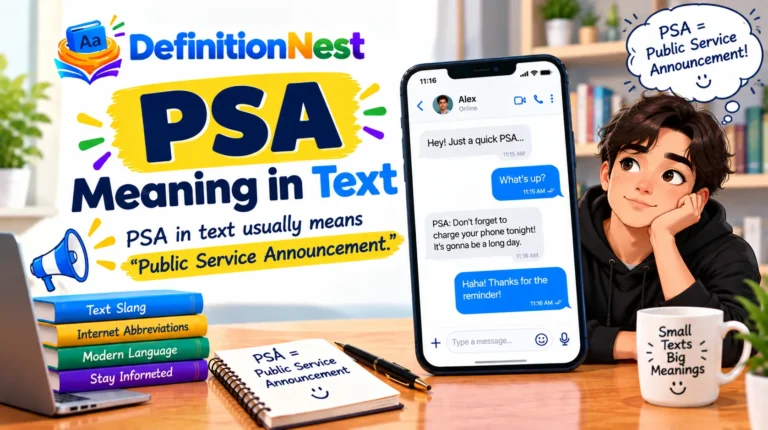
If you have seen “PSA” in a text, comment, group chat, or social media post, you may wonder what it means. In most online conversations, PSA means “Public Service Announcement.”
People use PSA when they want to share useful information, give a warning, make an important reminder, or tell a group of people about something they should know.
For example:
“PSA: The test is tomorrow, not Friday.”
Here, PSA means that the person is giving everyone an important reminder.
The good news is that PSA is easy to understand once you know how people use it online. It can sound serious, helpful, funny, or casual depending on the message around it.
This guide explains PSA meaning in text, how Gen Z uses it, what it means on social media, when to use it, and examples that make its meaning clear.
What Does PSA Mean in Text?
PSA in text usually means “Public Service Announcement.”
It is used before information that the writer thinks other people should know.
You may see it at the start of a sentence:
“PSA: School starts at 8 tomorrow.”
The person is not talking about a formal government announcement. They are simply using “PSA” to get attention before sharing useful information.
In texting, PSA can mean:
- Here is something important.
- I want everyone to know this.
- This is a useful reminder.
- Please pay attention to this.
- I need to tell you something that may help you.
- This information is worth sharing.
The exact meaning can change slightly based on the situation, but the main idea stays the same: the writer is making an announcement or sharing information with others.
PSA Meaning in Social Media
On social media, PSA is often used to introduce a public reminder or helpful tip.
You might see it on TikTok, Instagram, Facebook, X, Reddit, or in comments.
For example:
“PSA: Check the return policy before buying.”
This means the person wants other users to know that they should check the return policy.
Another example is:
“PSA: The new update changed the settings.”
The writer is alerting other people about a change.
Social media users also use PSA for small everyday facts. The information does not need to be a major announcement.
For example:
“PSA: You can save this post for later.”
In this case, PSA simply makes the statement stand out.
Because social media moves quickly, short terms like PSA help people get their point across without writing a long introduction.
Why Do People Say PSA in Texts?
People use PSA because it quickly tells readers that the next part of the message is worth noticing.
Instead of saying:
“I want to tell everyone something important that you should know.”
A person can simply write:
“PSA: Read this before you submit your form.”
It is shorter and more natural in online communication.
PSA can also make a message feel more organized. When someone starts with “PSA,” readers know that the person is about to share information.
It can be useful in:
- Group chats
- School chats
- Work chats
- Social media posts
- Online communities
- Comments
- Forums
- Text messages
- Community pages
The term works especially well when the writer wants several people to notice the same information.
PSA Meaning in Chat
In a chat, PSA usually means “Public Service Announcement.” However, the tone can be serious or playful.
For example:
“PSA: Bring your charger tomorrow.”
This is a simple reminder.
But someone might also write:
“PSA: Never trust me to remember where I put my keys.”
That is more playful. The person is joking while using the same PSA format.
This is common in casual online language. A phrase that originally sounds formal can become funny when used for an everyday situation.
So when you see PSA in a chat, do not automatically assume that something serious has happened. Look at the rest of the message to understand the tone.
PSA Meaning on Instagram
On Instagram, PSA is often used in captions, comments, Stories, and posts.
A creator may use it before sharing advice or a reminder.
For example:
“PSA: Always check the date before signing up.”
Another example:
“PSA: This event starts earlier than the poster says.”
The goal is usually to catch attention.
Because people often scroll quickly through social media, putting PSA at the beginning can make a message easier to notice.
It can also be used before personal opinions:
“PSA: You do not need to follow every trend.”
Here, the writer is making a general statement for their audience.
PSA Meaning on TikTok
TikTok users may use PSA when they want to share a tip, warning, fact, or reminder with viewers.
For example:
“PSA: Save the video before you forget.”
Or:
“PSA: Read the full instructions before trying this.”
In TikTok culture, PSA can be a quick way to introduce information before the main point.
It may appear in:
- Video captions
- Text on videos
- Comments
- Replies
- Creator posts
The meaning remains Public Service Announcement, but the style is often casual.
Is PSA a Formal or Casual Word?
PSA can be both formal and casual.
The original idea of a public service announcement is formal. It refers to information shared with the public for awareness or safety.
But online users have turned PSA into a common casual expression.
For example, a formal use might be:
“PSA: Severe weather is expected tonight.”
A casual use might be:
“PSA: The best snacks are the ones you do not have to share.”
The first sounds serious. The second is clearly casual.
This is why context matters when reading internet slang.
How Gen Z Uses PSA
Gen Z often uses older abbreviations in new and playful ways. PSA is a good example.
The basic meaning stays the same, but the tone can change.
A Gen Z-style PSA may be:
- Direct
- Funny
- Dramatic
- Helpful
- Sarcastic
- Casual
- Attention-grabbing
For example:
“PSA: Stop sending five messages when one will work.”
This is a casual complaint.
Another example:
“PSA: The assignment deadline changed.”
This is a useful announcement.
The word “PSA” gives both messages an announcement-like feeling without making the conversation sound too formal.
PSA vs FYI: What Is the Difference?
PSA and FYI are similar, but they are not exactly the same.
FYI means “For Your Information.”
It usually means:
“I am giving you this information so you know.”
PSA means “Public Service Announcement.”
It usually has a stronger announcement or reminder feeling.
Compare these examples:
“FYI, the meeting starts at 10.”
This simply gives information.
“PSA: The meeting starts at 10, so do not be late.”
This sounds more like a reminder to a group.
The two abbreviations can sometimes be used in similar situations, but PSA often feels more attention-grabbing.
Quick Difference
| Term | Meaning | Common Use |
|---|---|---|
| PSA | Public Service Announcement | Reminder or announcement |
| FYI | For Your Information | Sharing information |
| BTW | By the Way | Adding another point |
| IMO | In My Opinion | Sharing an opinion |
| TMI | Too Much Information | Information that feels excessive |
Knowing these differences can make online conversations easier to understand.
PSA vs Announcement
An announcement is any message that tells people about something.
A PSA is a type of announcement, but it usually focuses on information that may be useful to a wider group.
For example:
“Announcement: Our class meeting is at 2.”
This is a basic announcement.
“PSA: Everyone needs to bring their project tomorrow.”
This sounds more like a public reminder.
In everyday texting, however, people may use PSA and announcement almost interchangeably.
Is PSA Always Serious?
No. PSA is not always serious.
Online users often use it for humor.
For example:
“PSA: Pizza tastes better when someone else orders it.”
There is no real public warning here. The writer is using PSA as a funny way to introduce an opinion.
Another example:
“PSA: If you borrow my pen, please return it.”
This could be serious or playful depending on the conversation.
The surrounding words, punctuation, and situation help you understand the tone.
Examples of PSA in Text Messages
Here are some simple examples of how PSA can appear in everyday texts.
Example 1: School
“PSA: Our science test is on Thursday.”
Meaning: The person is reminding everyone about the test.
Example 2: Group chat
“PSA: We are meeting at 5, not 6.”
Meaning: The person wants everyone to know the correct time.
Example 3: Social media
“PSA: Read the instructions before downloading anything.”
Meaning: The person is giving a useful warning.
Example 4: Casual
“PSA: This is the best sandwich place.”
Meaning: The person is strongly recommending something.
Example 5: Funny
“PSA: Do not text me before breakfast.”
Meaning: The person is making a playful statement.
Example 6: Reminder
“PSA: The deadline is tonight.”
Meaning: The person wants others to remember an important deadline.
How to Use PSA Correctly
Using PSA is simple.
Put PSA: at the beginning of your message when you want to highlight information.
A basic pattern is:
PSA: + important information
Examples:
“PSA: The library closes early today.”
“PSA: Bring your ID tomorrow.”
“PSA: The deadline has moved to Monday.”
You do not need to explain what PSA means every time you use it with people who already understand internet slang.
For formal writing, however, writing “Public Service Announcement” may be better than using the abbreviation.
When Should You Use PSA?
PSA works best when you are talking to more than one person or sharing information that could help others.
Good situations include:
- Giving a group reminder
- Sharing a useful tip
- Warning people about a mistake
- Correcting wrong information
- Announcing a change
- Sharing an important update
- Giving advice
- Making a playful public statement
For example:
“PSA: Double-check the address before you leave.”
This is useful because other people may benefit from the reminder.
When Should You Avoid PSA?
PSA may not be the best choice for every message.
If you are sending a very personal message to one person, “PSA” may sound strange.
For example:
“PSA: Can you call me?”
This is possible, but it does not sound natural because the message is personal rather than public.
Instead, you could simply say:
“Can you call me?”
You should also avoid using PSA too often. If every message begins with PSA, it can lose its impact.
Use it when you really want to draw attention to the information.
Can PSA Be Used in a Funny Way?
Yes. This is one of the most common casual uses of PSA online.
People sometimes use the serious-sounding phrase for ordinary topics.
For example:
“PSA: Never start a movie when you have homework.”
Or:
“PSA: Sleep is important before a big day.”
The humor comes from treating a normal opinion or reminder like an official public announcement.
This style is common in memes, captions, comments, and group chats.
What Does PSA Mean in a Comment?
When someone writes PSA in a comment, they usually want other readers to notice the information that follows.
For example:
“PSA: The link is in the original post.”
The commenter is helping other people find something.
Another example:
“PSA: This information is outdated.”
Here, the person is warning other readers that they should be careful with the information.
The meaning is still Public Service Announcement.
What Does PSA Mean in a Group Chat?
In a group chat, PSA is especially useful because the message may be intended for everyone.
For example:
“PSA: Tomorrow’s class starts at 9.”
Instead of sending separate messages to each person, one person can make a public reminder in the group.
It can also be used for plans:
“PSA: Everyone needs to bring their own notebook.”
Or:
“PSA: The meeting location has changed.”
These messages are short, clear, and easy for a group to understand.
Does PSA Have Other Meanings?
Yes. PSA can have different meanings outside texting.
In online conversations, “Public Service Announcement” is one of the most common meanings.
But PSA can also refer to different terms in medicine, science, business, education, and other fields.
That means you should not assume that PSA always means “Public Service Announcement.”
Context is important.
If someone writes:
“PSA: Please check this update.”
It probably means Public Service Announcement.
But if PSA appears in a specialized document or professional conversation, it could mean something else.
When you are unsure, look at the words around the abbreviation.
What Does “PSA” Mean From a Friend?
If a friend sends:
“PSA: You need to watch this movie.”
They are probably using PSA casually to get your attention.
If they say:
“PSA: Don’t forget our plans tomorrow.”
They are giving you a reminder.
If they say:
“PSA: I just found the funniest video.”
They are using PSA in a playful way.
So the meaning depends on the message, but the general idea is “pay attention to this information.”
PSA Meaning in Simple English
If you want the easiest possible definition:
PSA means “Public Service Announcement.”
In texting, it usually means:
“Here is something I want people to know.”
It can introduce:
- A reminder
- A warning
- A tip
- An update
- Useful information
- A funny statement
For most casual online conversations, this simple definition is enough.
Frequently Asked Questions
What does PSA stand for in texting?
PSA usually stands for Public Service Announcement. In texting, people use it before a reminder, warning, tip, or important piece of information.
What does PSA mean on social media?
On social media, PSA usually means Public Service Announcement. It is often used to get attention before sharing information with followers or other users.
Is PSA slang?
PSA is an abbreviation rather than traditional slang, but it is widely used in casual internet language. People often use it in texts, comments, captions, and group chats.
Is PSA rude?
No. PSA is not rude by itself. The tone depends on the message. It can be helpful, serious, funny, or playful.
What is the difference between PSA and FYI?
FYI means “For Your Information,” while PSA means “Public Service Announcement.” FYI usually shares information with someone, while PSA often feels more like a public reminder or announcement.
Can I use PSA in a text message?
Yes. PSA is common in casual text messages, especially when you want a group of people to notice a reminder or update.
Does PSA always mean Public Service Announcement?
No. PSA can have other meanings in different subjects. However, in casual texting and social media, Public Service Announcement is a common meaning.
What does “PSA:” at the beginning of a message mean?
When someone starts a message with “PSA:”, they are usually saying, “Pay attention to this information.” What follows is normally a reminder, tip, warning, or announcement.
Final Answer:
So, what does PSA mean in text?
In most texting and social media situations, PSA means “Public Service Announcement.”
People use it to introduce information they want others to notice. It can be used for serious reminders, helpful tips, warnings, updates, or even jokes.
For example:
“PSA: The deadline is tomorrow.”
The meaning is simple: the person wants everyone to know something important.
PSA can sound formal because of its original meaning, but online users often use it in a relaxed and funny way.
That is why you may see it in group chats, TikTok comments, Instagram captions, posts, and everyday texts.
When you see PSA in a casual message, think:
“Here is something you should know.”
That simple idea will help you understand most uses of PSA online.

Matthew Collins is a language enthusiast and content writer who specializes in explaining word meanings, abbreviations, and internet slang in a simple and easy-to-understand way.