
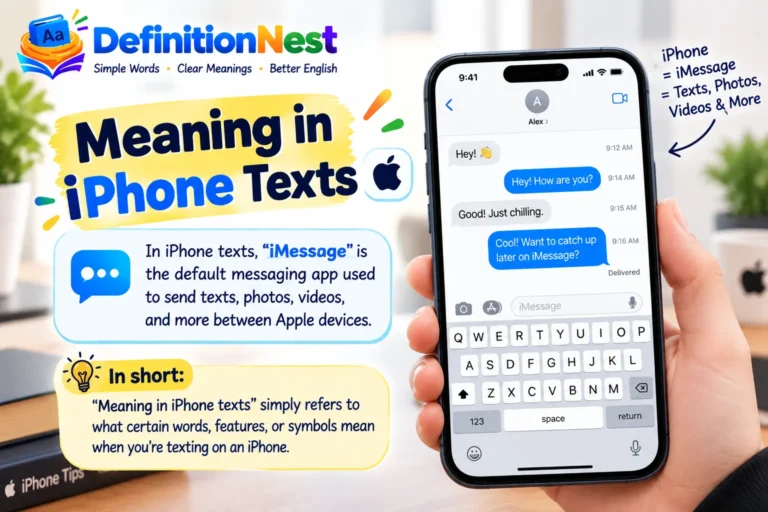
When someone sends you a short message on an iPhone, it can sometimes be hard to know what they mean.
A few letters, a symbol, or a short phrase can have more than one meaning. This is why people search for meaning in iPhone texts when they see something they do not understand.
Texting has its own style. People often use short words, slang, abbreviations, and symbols to save time. The meaning can also change based on the conversation.
A word that sounds friendly in one message may sound cold or serious in another.
iPhone texting can add more confusion because messages may include reactions, tapbacks, read receipts, typing indicators, effects, and other features.
A person may also use slang that is common on social media but not familiar to everyone.
The good news is that most text meanings are easy to understand once you look at the context.
This guide explains how to read common meanings in iPhone texts, how slang works, and how to avoid misunderstandings in 2026.
Understanding Meaning in iPhone Texts
The meaning of a text is not always found in one word. You should look at the whole message and the conversation around it.
For example, if someone sends:
“Sure.”
The word itself sounds simple. But its meaning can change based on the situation.
If you asked, “Can you send me the notes?” and the person replies, “Sure,” they probably mean yes.
But if you had an argument and the person sends only “Sure,” it may sound less friendly.
This shows why context matters.
When trying to understand meaning in iPhone texts, ask yourself:
- What was said before the message?
- Who sent the message?
- Is the person joking?
- Are they using slang?
- Is the message short because they are busy?
- Did they add a punctuation mark or reaction?
- Does the person normally text this way?
These small details can help you understand the real message.
Why iPhone Texts Can Be Confusing
Text messages do not show facial expressions or voice tone. When someone speaks to you, you can often tell if they are joking, upset, excited, or serious.
A text does not always give you those clues.
For example:
“Okay”
could mean:
- Yes
- I understand
- I agree
- I am busy
- I do not want to talk more
- I am upset
The correct meaning depends on the conversation.
iPhone users may also use abbreviations such as “idk,” “brb,” “btw,” “lol,” “tbh,” and “omw.” These are common in online conversations, but not everyone knows them.
New slang also appears often. A term may become popular on TikTok, Instagram, Snapchat, gaming platforms, or group chats and then move into normal texting.
This is why a simple message may need more attention than it first seems.
Common Short Forms in iPhone Texts
Short forms are one of the biggest reasons people search for text meanings.
Here are some common examples:
IDK means “I don’t know.”
Example:
“IDK what time we are leaving.”
BTW means “by the way.”
Example:
“BTW, did you finish your homework?”
BRB means “be right back.”
Example:
“BRB, I need to get some water.”
TBH means “to be honest.”
Example:
“TBH, I liked the first movie more.”
LOL is often used to show that something is funny. It can also be used lightly at the end of a message.
Example:
“I forgot my keys again lol.”
OMG means “oh my gosh” or “oh my God.” It is often used to show surprise.
Example:
“OMG, I forgot about the test.”
BTW, IDK, and similar terms can make texting faster. Their exact tone still depends on the message.
Context Changes the Meaning
One of the most important rules for understanding text slang is simple: context matters.
Imagine someone sends:
“SC”
That short form could have different meanings depending on the conversation. Someone may use it for Snapchat, a location, a school term, a gaming term, or something personal to their group.
The same idea applies to many other abbreviations.
A person might use “rn” to mean “right now.”
“I’m busy rn.”
Another person may use a short form that is common only among their friends.
So, do not assume that every abbreviation has one fixed meaning.
If you are unsure, you can ask:
“What do you mean by that?”
That is often better than guessing.
Text Reactions on iPhone
iPhone messages can include reactions, often called Tapbacks. These allow a person to react to a message without typing a full reply.
A reaction may show that someone:
- Likes a message
- Dislikes a message
- Agrees with it
- Finds it funny
- Is surprised
- Wants to point out that they noticed it
However, reactions can still be misunderstood.
For example, if someone reacts to your message instead of writing a reply, it does not always mean they are angry or ignoring you. They may simply be saying, “I saw this.”
The meaning also depends on the type of message.
If you send:
“Thanks for helping me!”
and the person reacts positively, the reaction is likely friendly.
If you send a serious question and receive only a reaction, you may still need a written answer.
Punctuation Can Change Tone
Punctuation can affect how an iPhone text feels.
Compare:
“Okay”
with:
“Okay!”
The second one may sound more excited or positive.
Now compare:
“Okay.”
The period may make the message feel more serious or final to some readers.
But this is not a strict rule. Some people use periods in every message and do not mean anything negative.
This is why you should learn the sender’s normal texting style before deciding what a punctuation mark means.
Someone who always writes complete sentences may use periods simply because that is their habit.
What “K” Can Mean in a Text
“K” usually means “okay,” but the tone can vary.
For example:
“Can you meet at 5?”
“K.”
This could simply mean yes.
However, in some conversations, a very short “K” may feel less warm than:
“Okay!”
or:
“Sure!”
Do not automatically assume that “K” means someone is angry. Look at the rest of the conversation and the person’s normal texting style.
What “Okay” Can Mean
“Okay” is one of the most flexible words in texting.
It can mean:
- I understand.
- I agree.
- That is fine.
- I will do it.
- I heard you.
- Let us move on.
Tone is important.
“Okay, sounds good!” usually feels positive.
“Okay…” may sound uncertain or uncomfortable.
“Okay.” can feel short or serious, but it may also be completely normal for some people.
What “Sure” Can Mean
“Sure” often means yes or agreement.
Example:
“Can you help me later?”
“Sure.”
In another situation, it could sound doubtful.
Example:
“Are you really going to finish all that today?”
“Sure.”
The second example may be playful or sarcastic depending on the conversation.
This is another reason why searching for a single dictionary meaning is not always enough.
Slang in Modern iPhone Texting
Modern texting changes quickly. Words can gain new meanings through social media and online communities.
Some terms may be used differently by different age groups or online groups.
For example, a slang word may be:
- A joke
- A compliment
- An insult
- A reaction
- A way to show agreement
- A way to show disbelief
The safest way to understand new slang is to check the full sentence.
Do not judge a word by its most common dictionary definition. Online language can work differently.
Meaning Depends on Who Is Texting
The person sending the message matters.
A close friend may use slang that would sound strange in a school or work message.
For example:
“Bro, that was wild”
may be normal between friends.
But the same style may not fit every situation.
People also create private abbreviations. A friend group may use a few letters to refer to a person, place, event, joke, or shared memory.
If you do not understand it, there may be no universal definition.
In that case, asking the sender is the best choice.
Meaning in iPhone Texts and Social Media
Texting language and social media language are closely connected.
People often move slang between:
- iPhone Messages
- Snapchat
- TikTok
- Discord
- Online games
- Group chats
A word that becomes popular on one platform can quickly appear in regular text messages.
This can make language hard to follow, especially when a new term becomes popular quickly.
However, popularity does not mean everyone uses the term in the same way.
Always consider the person and the conversation.
How to Tell if a Text Is Friendly
Friendly texts often include extra words, questions, or positive language.
Examples include:
“Sounds good!”
“Yeah, I can do that.”
“Thanks!”
“Sure, no problem.”
But short messages are not automatically unfriendly.
Someone may send:
“Yep”
because they are in class, working, traveling, or simply busy.
A short message does not always show a person’s feelings.
How to Tell if a Text Is Serious
Serious texts often become clearer from the topic.
For example:
“We need to talk about what happened.”
This is more serious than:
“lol that was funny.”
Still, do not try to guess someone’s feelings from one punctuation mark or one short word.
Look at the full conversation.
If the message matters, asking a simple question can prevent a misunderstanding.
How to Ask What a Text Means
If you do not understand an abbreviation, you do not need to guess.
You can simply say:
“What does that mean?”
Or:
“What does that abbreviation mean?”
You can also ask:
“Do you mean ___?”
This gives the other person a chance to explain.
Asking is especially useful when a message could have more than one meaning.
Common Mistakes When Reading Text Messages
One common mistake is assuming that a short message is rude.
For example:
“Fine.”
might feel cold to you. But the sender may simply have a short texting style.
Another mistake is assuming that slang has one meaning everywhere.
A third mistake is reading too much into punctuation.
Not everyone uses punctuation to show emotion.
Another mistake is ignoring the previous messages.
The conversation before a message often gives the biggest clue to its meaning.
Why Texting Habits Matter
Every person has a different texting style.
Some people write:
“Hey! How are you?”
Others write:
“hey u good”
Neither style automatically tells you how the person feels.
Some people reply quickly. Others take longer.
Some use many abbreviations. Others write full sentences.
Some people use reactions often. Others rarely use them.
Knowing these habits can help you understand messages better.
Understanding Group Chats
Group chats can make text meanings even harder to understand.
A group may have:
- Inside jokes
- Personal abbreviations
- Nicknames
- Shared slang
- Gaming terms
- School-related terms
- References that only the group understands
If you join a new group chat, you may see words that seem confusing at first.
Instead of guessing, look at how the group uses the word several times. The meaning often becomes clear from context.
When a Text Has More Than One Meaning
Some words simply cannot be understood without context.
For example, “SC” may mean different things in different conversations.
Likewise, “cap” can have a slang meaning related to lying, while in another situation it may simply refer to a hat.
“Fire” can mean something is very good in slang, but it can also mean actual fire.
This is why a search result alone may not always give the right answer.
The sentence and situation are important.
How to Find the Right Meaning
When you see an unfamiliar term in an iPhone text, follow these steps:
First, read the full message.
Do not focus only on the unfamiliar word.
Next, read the messages before it.
The earlier conversation may explain the term.
Then, think about the person.
A close friend may use slang differently from a teacher or family member.
Look at the platform.
Some terms are common on gaming apps or social media but less common in normal texting.
Finally, ask if you are still unsure.
A quick question is better than a wrong assumption.
iPhone Texting and New Slang in 2026
Texting language continues to change in 2026.
New slang can appear quickly because social media spreads words at a very fast rate. A term may become popular for a few months and then become less common.
This means online slang should not be treated like a fixed dictionary.
Some terms stay popular for years. Others disappear quickly.
For this reason, the best way to understand meaning in iPhone texts is to combine the word’s common meaning with the context in which it appears.
Should You Always Search a Text Meaning?
Not always.
If you understand the message from context, there may be no need to search it.
Search when:
- You do not know the abbreviation.
- The word seems to have several meanings.
- The message comes from an unfamiliar online community.
- The term is new slang.
- The meaning could affect your response.
If the message is personal or important, asking the sender may be more accurate than relying on a general slang definition.
FAQs
What does “Meaning in iPhone Texts” refer to?
“Meaning in iPhone Texts” refers to the definitions and explanations of words, abbreviations, emojis, and slang terms commonly used in text messages on iPhones.
Are iPhone text abbreviations different from Android text abbreviations?
No, most text abbreviations and slang terms are the same across iPhone and Android devices. Their meanings usually depend on the conversation rather than the phone type.
Why do people use abbreviations in iPhone texts?
People use abbreviations to save time, type faster, and make conversations more casual and convenient.
How can I understand unfamiliar terms in iPhone messages?
You can look at the context of the conversation or search for the meaning of the abbreviation, slang term, or emoji online.
What are some common terms used in iPhone texts?
Popular examples include LOL (Laugh Out Loud), BRB (Be Right Back), IMO (In My Opinion), and TTYL (Talk To You Later). These abbreviations are widely used in text messaging and social media.
Final Thoughts
Understanding meaning in iPhone texts is mostly about context. A word, abbreviation, reaction, or punctuation mark may have different meanings depending on the person and situation.
Do not assume that every short reply is rude. Do not assume that every abbreviation has one definition. And do not judge a person’s feelings from one word alone.
Instead, read the complete conversation, consider the sender’s normal texting style, and look at where the term is being used.
If you still do not understand a message, asking is simple. A quick “What do you mean?” can clear up confusion and prevent a small text from becoming a bigger misunderstanding.
As iPhone texting and social media language continue to change in 2026, understanding context will remain one of the best ways to understand modern online communication.

Matthew Collins is a language enthusiast and content writer who specializes in explaining word meanings, abbreviations, and internet slang in a simple and easy-to-understand way.
7 thoughts on “Meaning in iPhone Texts: Easy Guide to Texting in 2026 Today”