
FWB is one of those texting terms that can confuse people when they first see it.
You might receive a message that says, “Are you looking for an FWB?” or notice the term on social media, dating apps, or online chats. If you do not know what it means, it can be hard to understand the person’s intention.
Many people search for FWB meaning in text because the abbreviation often appears in conversations where context matters.
The meaning can affect how you respond and how you interpret the message. A simple misunderstanding can lead to confusion, especially in online communication.
The good news is that FWB is not a complicated term once you know what it stands for.
Understanding it can help you communicate more clearly and avoid making incorrect assumptions about someone’s message.
In this guide, you will learn the exact meaning of FWB in texting, where people use it, how it appears in real conversations, when it may sound flirty, and the best ways to respond when someone uses it.
What Does “FWB” Mean in Text?
FWB most commonly means “Friends With Benefits.” It describes a friendship where two people have a physical or romantic relationship without being in a committed dating relationship.
In texting and online conversations, FWB is usually used when discussing dating, relationships, or personal connections. While Friends With Benefits is the main meaning, some people may occasionally use it differently based on context. However, the relationship-related meaning is by far the most common interpretation.
The Most Common Meanings of “FWB”
Friends With Benefits
This is the most popular meaning of FWB.
It refers to two people who are friends but also share a physical relationship without the expectations of a traditional romantic partnership.
Example:
- “We are just FWB, nothing serious.”
- “They started as friends and became FWB.”
Potential Relationship Discussion
Sometimes people use FWB while discussing the type of relationship they want.
Example:
- “I am not looking for a serious relationship, maybe just FWB.”
In this situation, the term describes relationship preferences rather than an existing relationship.
Online Dating Context
FWB often appears on dating apps where users describe what they are looking for.
Example:
- “Interested in meeting someone as an FWB.”
Here, the abbreviation helps people communicate their intentions quickly.
General Relationship Conversations
People may also use FWB when talking about relationship topics, advice, or personal experiences.
Example:
- “Have you ever had an FWB situation before?”
The term is used as a conversation topic rather than a direct request.
How “FWB” Is Used in Real Conversations
Friends & Casual Texting
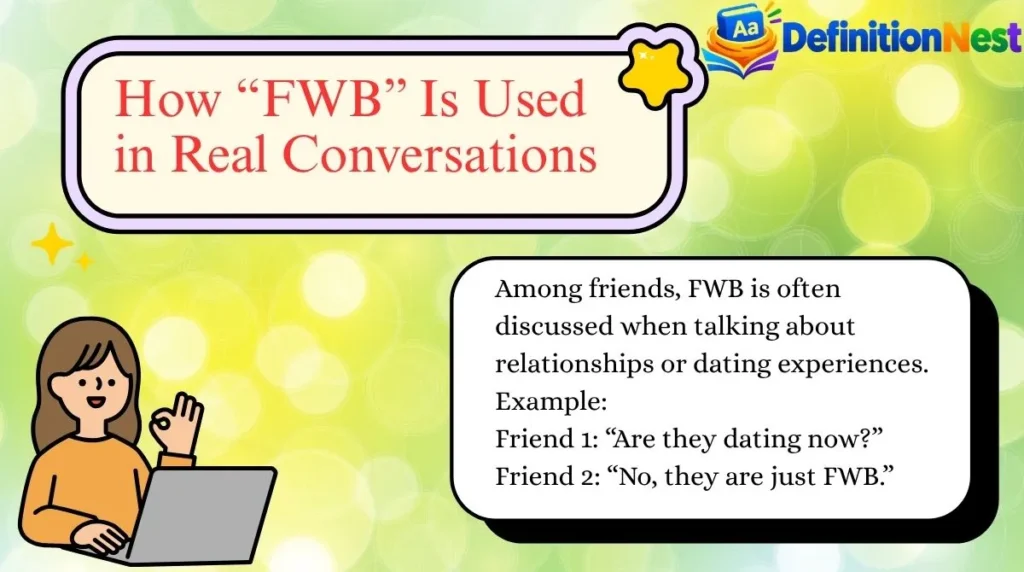
Among friends, FWB is often discussed when talking about relationships or dating experiences.
Example:
Friend 1: “Are they dating now?”
Friend 2: “No, they are just FWB.”
The term helps explain a relationship that is more than friendship but less than a committed partnership.
Instagram & Snapchat
On Instagram and Snapchat, FWB may appear in captions, comments, private messages, or story replies.
Example:
- “People always confuse dating and FWB.”
- “Not looking for anything serious, just FWB.”
In these spaces, the abbreviation is usually used casually.
Dating Apps
Dating apps are one of the most common places where FWB appears.
Users often mention it in profiles to explain what type of connection they want.
Example:
- “Open to an FWB arrangement.”
- “Looking for FWB, not a serious relationship.”
Because intentions matter on dating platforms, understanding the term is important.
Gaming & Online Communities
Gaming chats and online communities sometimes include conversations about relationships.
Example:
- “My FWB also plays this game.”
The meaning stays the same, but the discussion happens in a different environment.
Work or Professional Chat
FWB is generally uncommon in professional communication.
If someone uses the term in a workplace chat, it is usually part of a personal discussion rather than work-related communication.
Example:
- “I prefer not to discuss FWB topics at work.”
Professional settings typically avoid relationship slang.
Is “FWB” Rude, Flirty, or Offensive?
FWB is not automatically rude, but its tone depends heavily on context.
In many situations, it is considered a neutral relationship term. People use it simply to describe a type of connection between two individuals.
However, it can sound flirty when someone uses it while discussing personal interests or relationship preferences.
Positive Situations
- Honest conversations
- Relationship discussions
- Mutual understanding
- Dating app profiles
Negative Situations
- Unwanted personal questions
- Inappropriate workplace conversations
- Messages that make someone uncomfortable
The psychology behind the term is simple. People often use FWB because it quickly communicates relationship expectations. Problems usually happen when two people interpret the term differently.
For some people, it feels casual and harmless. For others, it may feel too personal. Understanding the audience is important before using it.
How to Respond When Someone Says “FWB”
Casual Replies
If you are simply continuing the conversation, you can respond naturally.
- “I understand what you mean.”
- “Thanks for explaining.”
- “That makes sense.”
Funny Replies
Humor can work when the conversation is already lighthearted.
- “That sounds complicated.”
- “Texting slang gets more interesting every day.”
- “I had to look that one up.”
Neutral Replies
Neutral responses are useful when you want more information.
- “Can you explain what you mean?”
- “Are you talking about Friends With Benefits?”
- “What exactly are you looking for?”
Professional Replies
In professional environments, it is usually best to redirect the conversation.
- “Let’s keep the discussion work-related.”
- “I would rather focus on the project.”
- “That is a personal topic.”
Professional responses help maintain boundaries.
Common Misunderstandings About “FWB”
Assuming It Means Dating
One common mistake is thinking FWB automatically means a traditional romantic relationship.
In reality, the term usually describes a relationship without formal commitment.
Believing Everyone Uses It the Same Way
Different people may have different expectations when discussing FWB.
One person may view it casually, while another may expect stronger emotional involvement.
Ignoring Context
Context matters.
The same abbreviation can feel neutral in one conversation and highly personal in another.
Misreading the Tone
Some people think FWB is always flirtatious.
That is not necessarily true. It can simply be a descriptive term during a discussion about relationships.
Confusing It With Similar Terms
FWB is often confused with terms like:
- Dating
- Situationship
- Hookup
- Casual relationship
While these concepts may overlap, they are not always identical.
Understanding the differences prevents confusion.
Similar Slang Terms You Should Know
BFF
Best Friends Forever.
GF
Girlfriend.
BF
Boyfriend.
Situationship
A relationship without clear labels or commitment.
Crush
Someone you are romantically interested in.
Talking Stage
The early phase before a relationship becomes official.
OTP
One True Pairing, often used online for favorite couples.
BAE
A term of affection for a romantic partner.
HMU
Hit Me Up, meaning contact me.
WYLL
What You Look Like.
IRL
In Real Life.
DM
Direct Message on social media platforms.
These terms frequently appear alongside FWB in texting and online communication.
When You Should Avoid Using “FWB”
Professional Settings
Workplaces are usually not appropriate places for relationship slang.
Using FWB in professional communication may create discomfort or misunderstandings.
Cross-Cultural Chats
Not everyone is familiar with modern English internet slang.
Some people may misunderstand the term completely.
Sensitive Situations
Avoid using FWB when discussing serious emotional topics unless it is directly relevant.
Clear language is often better in sensitive conversations.
Conversations With Younger Audiences
Because FWB relates to adult relationship discussions, it may not be suitable for all audiences.
Formal Communication
Formal emails, business messages, and academic communication should avoid slang whenever possible.
Using complete and professional language is usually the better choice.
FAQs
What does FWB stand for in text messages?
FWB usually stands for Friends With Benefits, referring to a friendship that includes a physical relationship without a committed romantic partnership.
Is FWB a dating term?
Yes. FWB is commonly used in dating and relationship discussions, especially on dating apps and social media.
Is FWB the same as a boyfriend or girlfriend?
No. An FWB relationship is generally different from a committed boyfriend-girlfriend relationship.
Can FWB be used on Snapchat and Instagram?
Yes. Many people use FWB in messages, comments, captions, and private chats on social media platforms.
Is FWB considered rude?
Not usually. It is generally a neutral term, but it can feel inappropriate depending on the situation and audience.
Should I ask someone what they mean by FWB?
Yes. If the context is unclear, asking for clarification is the best way to avoid misunderstandings.
Why do people use FWB instead of writing the full phrase?
People use FWB because it is short, easy to type, and widely recognized in online conversations.
Final Thoughts
Understanding FWB meaning in text is important because the abbreviation appears frequently in modern online communication.
In most cases, FWB stands for Friends With Benefits, a term used to describe a friendship that includes a physical relationship without a committed romantic partnership.
The meaning itself is straightforward, but context always matters. The tone, platform, and conversation can change how the term is understood.
Whether you see FWB in a text message, Snapchat chat, Instagram comment, dating app profile, or online discussion, knowing its meaning helps you respond appropriately and avoid confusion.
When you are unsure about someone’s intention, asking for clarification is always the smartest approach.
The more you understand modern texting slang, the easier it becomes to communicate clearly and confidently online.

Matthew Collins is a language enthusiast and content writer who specializes in explaining word meanings, abbreviations, and internet slang in a simple and easy-to-understand way.